What should I check before crossing a bar or entering a harbour I don’t know?
Maritime Safety Queensland and Transport for NSW give the same core list. Know the tide and cross on the flood: the ebb, a run-out tide against the swell, is when a bar is at its worst. Check the weather and the swell for the crossing out and the crossing back. Watch the bar yourself or on its webcam. Log on and off with your local volunteer marine rescue by radio. In NSW everyone aboard wears a lifejacket on a coastal bar.
Then read the warnings. The Bureau issues bar cautions and coastal warnings, and AMSA broadcasts navigation warnings for Australian waters.
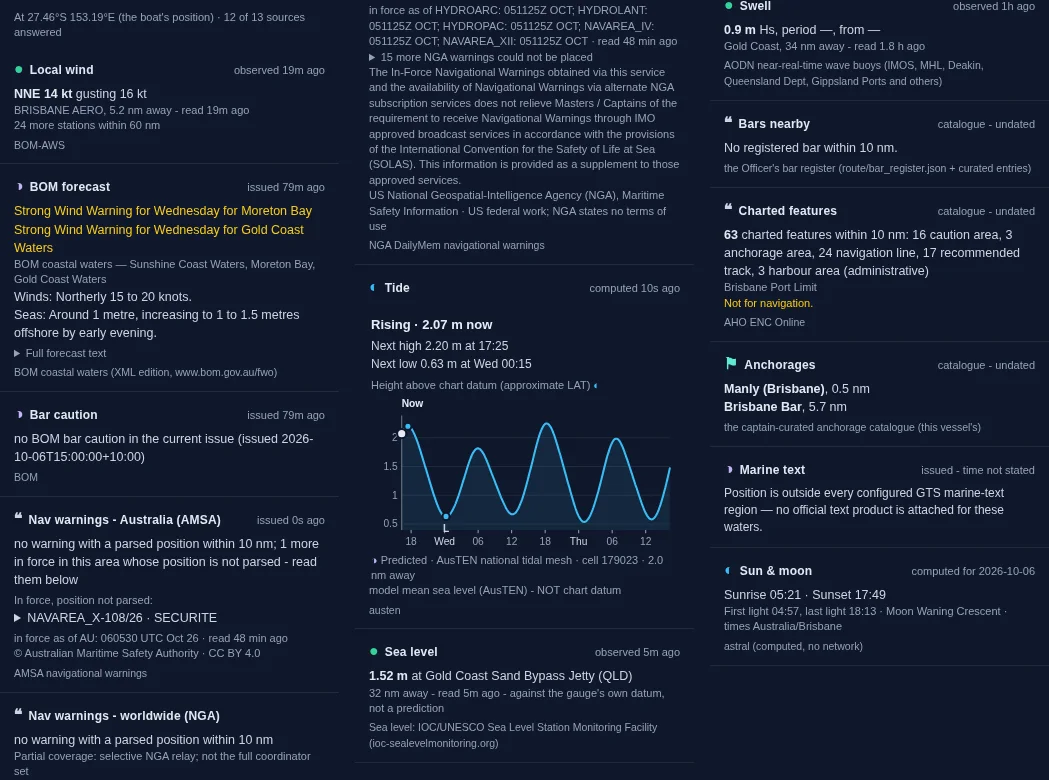
Shimbiri’s Local Knowledge puts that picture in one panel at the boat: the wind measured nearby, the Bureau forecast and any warnings, the bar caution, Australian and worldwide navigation warnings, the tide curve, the sea level measured at the nearest gauge, the swell at the nearest buoy, and the bars and anchorages within 10 nm. Each line says where it came from and how old it is. It does not replace your log-on, or your own look at the bar.
Guidance from the state authorities’ pages, read 6 October 2026. Local Knowledge gathers the Bureau, AMSA, tide, sea level and buoy readings at the boat’s position.
General information for Australian operators, current as of 6 October 2026. Rules change and recreational rules vary by state. Always confirm against the source(s) linked above (your AMSA, Australian Sailing or state maritime authority). This is not legal advice.